Case Study

Client
Industry
Project Duration
6 months
Customer Vision
Moody's Analytics needed to score environmental and geopolitical risk across enterprises with thousands of physical locations worldwide. Expanding their ESG capabilities required a scalable way to feed those signals into credit risk and ratings.
Roko Labs built the data foundations and pipelines that powered location-level risk assessments. The work covered ingestion, enrichment, orchestration, and delivery. ESG risk scoring now runs across thousands of global assets.
The Challenge
Moody's faced four interconnected challenges:
Fragmented data sources across corporate structures, facilities, financials, and external risk providers
Complex corporate hierarchies: parent companies, subsidiaries, and operating entities across multiple geographies
Environmental and geopolitical risk evaluation at the individual location level, not the company level
Clean, structured, analyst-ready data feeding downstream credit and risk workflows
The risk scoring algorithms were owned by a third-party provider. Moody's needed infrastructure to feed those models with accurate, complete, and timely data at scale.
Approach
Roko Labs built a data pipeline that unified, enriched, and operationalized ESG risk data across Moody's global footprint.
The pipeline first mapped companies to physical assets, connecting internal datasets and resolving corporate hierarchies. Location-level ESG analysis runs on that foundation.
External financial and market data joined next. ESG signals could be analyzed alongside financial performance, sharpening credit evaluation.
A scalable input pipeline then fed the third-party ESG scoring API. It standardized and normalized data from multiple sources, letting Moody's score climate exposure, extreme weather, and regional instability at scale.
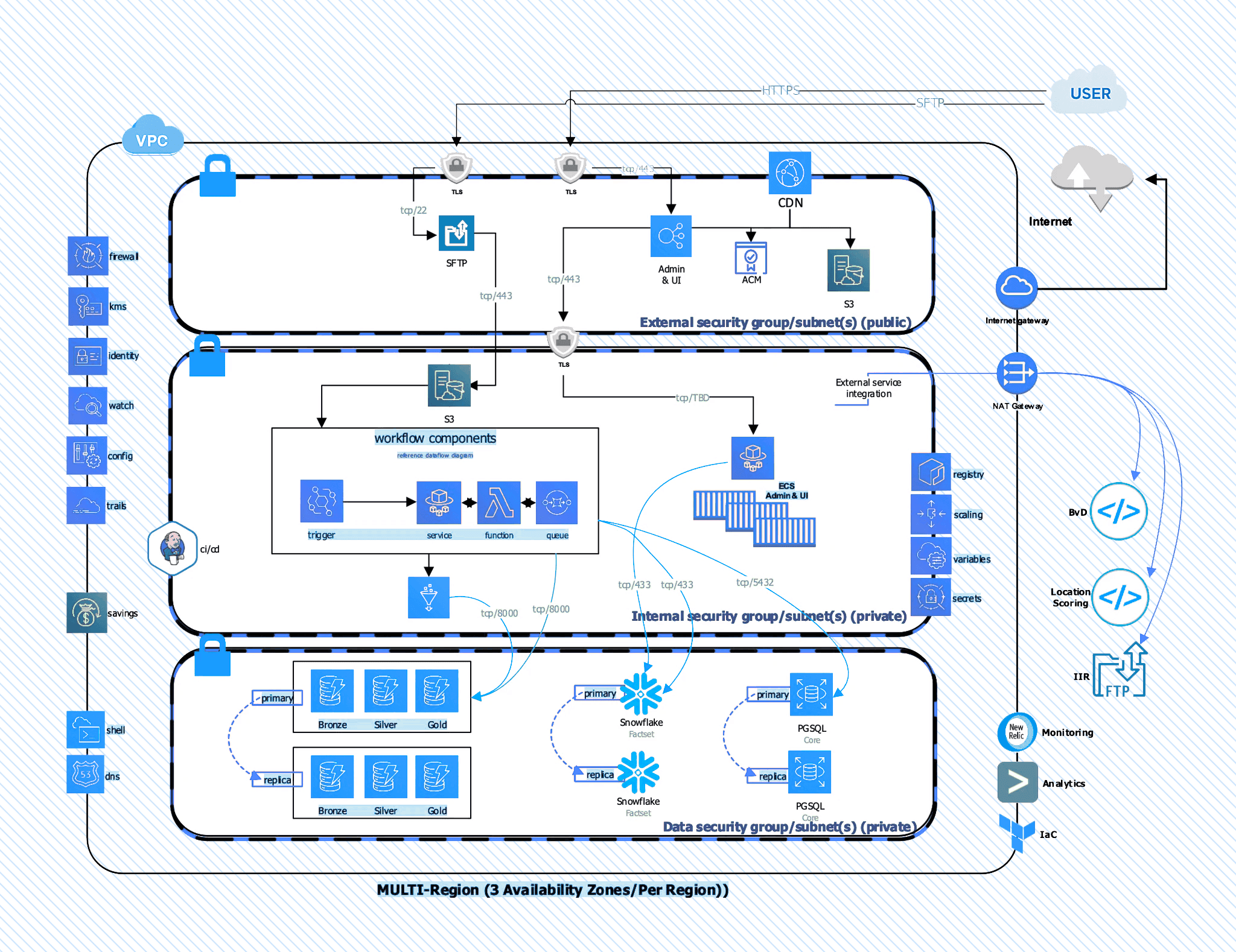
The entire flow runs on a layered cloud architecture, from raw ingestion to analytics-ready datasets. Every step is traceable and auditable.
Key Outcomes
The pipeline changed how Moody's runs risk analysis.
Analysts now pull location-level ESG risk scores directly into credit ratings. Environmental and geopolitical factors enter the rating with precision. The old approach was assumption-driven and high-level; the new one is granular and grounded in real-world conditions.
Risk now runs across thousands of locations per company, a scale the previous system could not reach.
Manual data preparation dropped sharply. Ingestion, enrichment, and downstream processing run automatically. Consistency improved and ESG insights reach analysts faster.
The architecture is built to extend. New models, new data sources, and new risk dimensions plug in without reworking the core.
Business Impact
Roko Labs unified Moody's fragmented ESG data into a single intelligence platform. Risk insights now reach analysts with the accuracy that credit ratings demand.
Environmental and geopolitical factors feed directly into credit risk evaluation. The ESG offering is sharper in the market. Clients get more grounded inputs to their decisions.
What started as data engineering is now a strategic capability. Location-based ESG analysis runs at scale, inside Moody's core workflows.