Case Study
Delivering Enterprise Analytics Through AI-Driven Rapid Prototyping & Customer Discovery
Case Study
Delivering Enterprise Analytics Through AI-Driven Rapid Prototyping & Customer Discovery
Client
A leading technology provider for financial content distribution, with clients such as Wells Fargo, Merrill Lynch, BlackRock, Edward Jones, and others.
Industry
Financial Software Wealth Management Investment Management
Services
Product Strategy Data Architecture Platform Engineering Analytics Infrastructure
Project Duration
3 months

Client
A leading technology provider for financial content distribution, with clients such as Wells Fargo, Merrill Lynch, BlackRock, Edward Jones, and others.
Industry
Financial Software Wealth Management Investment Management
Services
Product Strategy Data Architecture Platform Engineering Analytics Infrastructure
Project Duration
3 months

Client
A leading technology provider for financial content distribution, with clients such as Wells Fargo, Merrill Lynch, BlackRock, Edward Jones, and others.
Industry
Financial Software Wealth Management Investment Management
Services
Product Strategy Data Architecture Platform Engineering Analytics Infrastructure
Project Duration
3 months

Problem
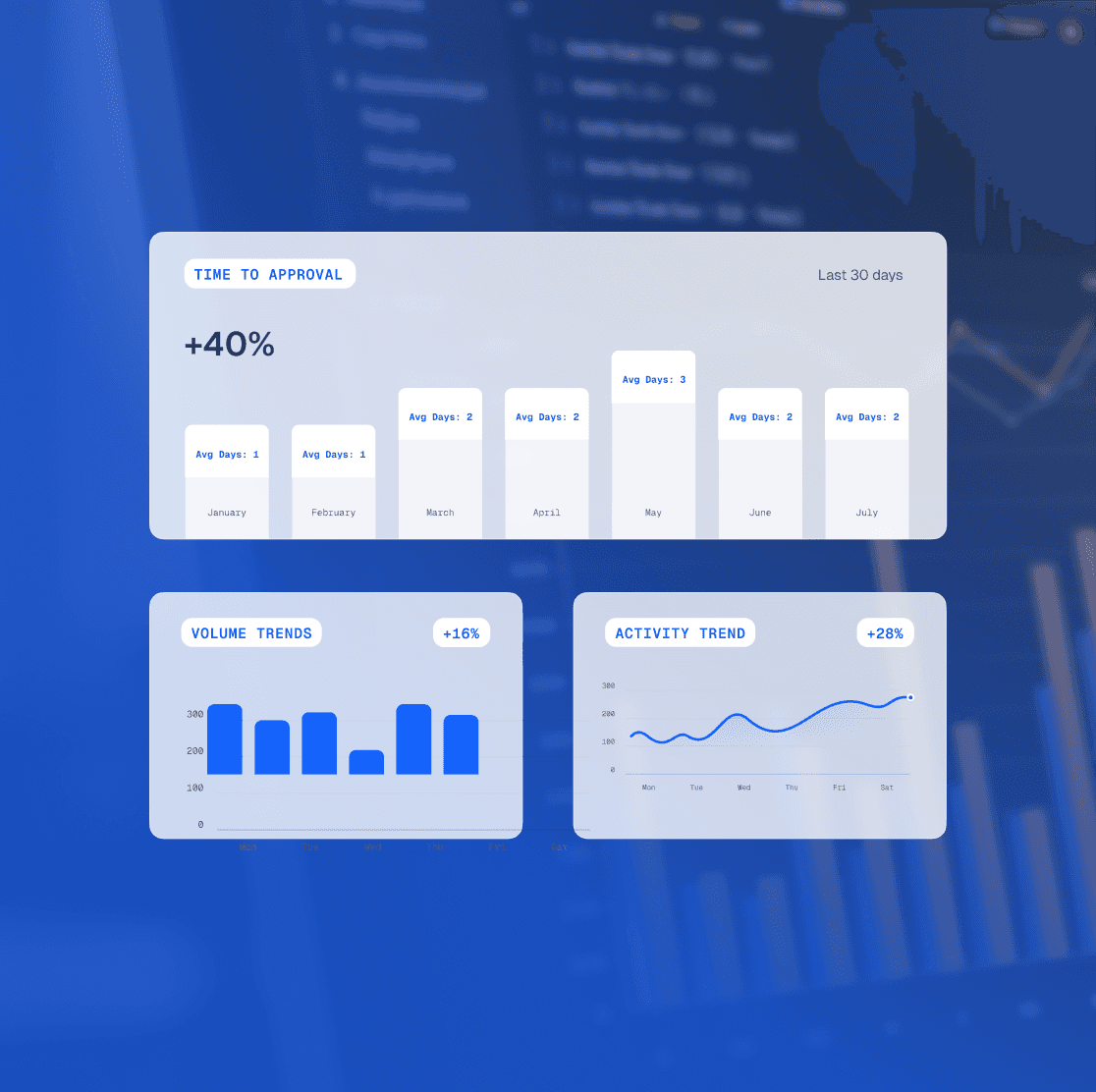
A major financial services SaaS platform needed a better way to understand metrics around their content submission and approval workflows for asset managers and financial institutions. These processes sit at the intersection of marketing, compliance, and distribution — and operate at significant scale. While the platform effectively manages the workflow itself, clients had limited visibility into how efficiently those workflows were performing. Client-internal teams needed to understand their submission volume, approval timelines, and operational bottlenecks. Instead, many were exporting data and building their own reports to calculate time-to-approval and throughput metrics. This created duplicated effort, inconsistent definitions, and fragmented insight across organizations. There was a clear opportunity to embed workflow intelligence directly into the product and deliver measurable operational transparency.
Our Vision
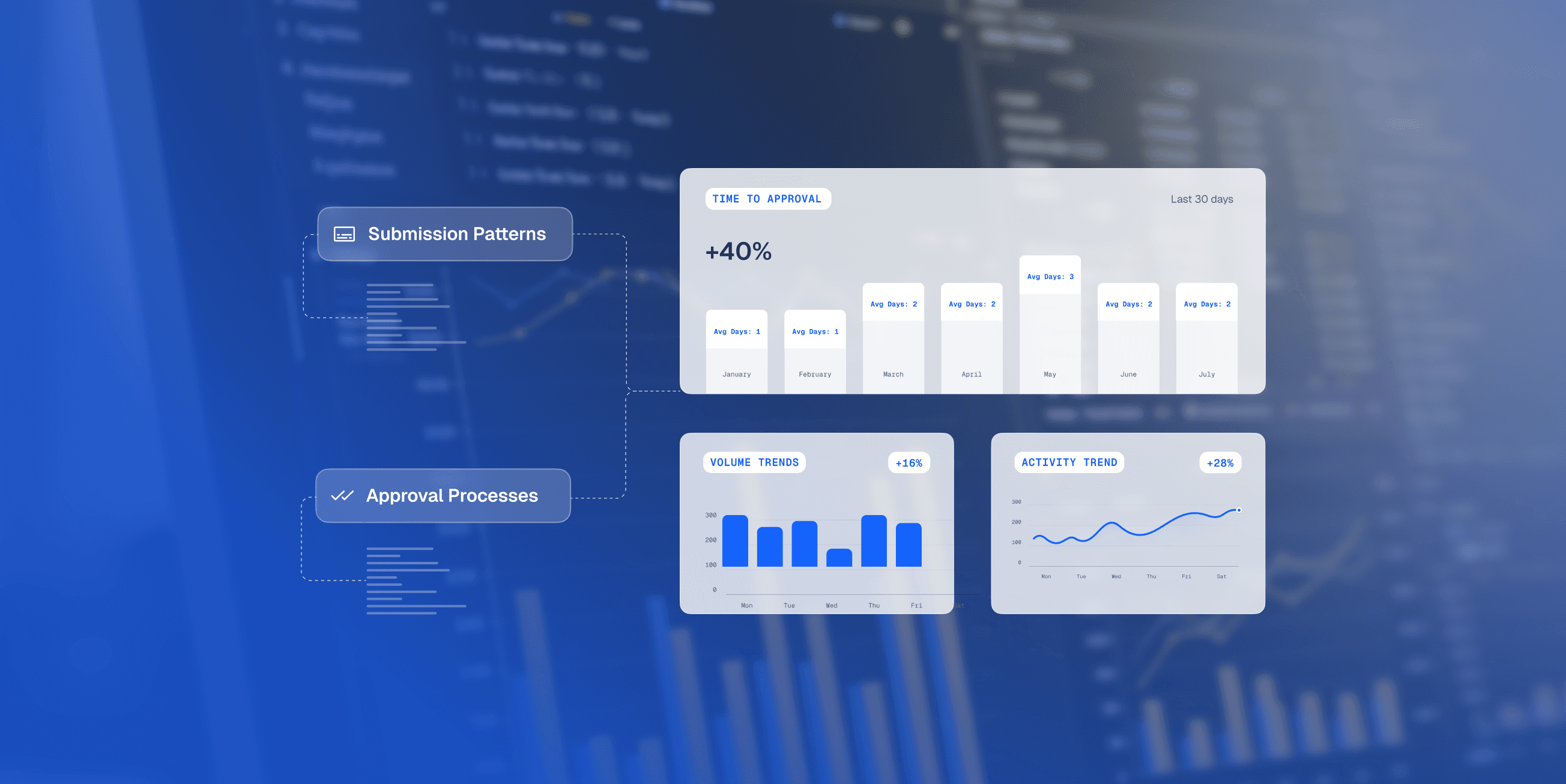
Roko Labs partnered with the client to transform workflow data into embedded operational intelligence. The objective was not simply to introduce new reports, but to surface high-impact metrics — including submission volume and time-to-approval — directly within the product experience. By integrating these analytics into the core workflow, the platform could provide clients with immediate, consistent visibility into performance without requiring external reporting. Delivering this value required more than interface updates. It called for a modernized data foundation capable of calculating metrics reliably at scale, standardizing definitions across customers, and supporting future analytics expansion. The vision was to evolve the platform from a system that manages workflows to one that also measures and improves them — strengthening its role as both an operational backbone and a source of strategic insight.
Problem
A major financial services SaaS platform needed a better way to understand metrics around their content submission and approval workflows for asset managers and financial institutions. These processes sit at the intersection of marketing, compliance, and distribution — and operate at significant scale. While the platform effectively manages the workflow itself, clients had limited visibility into how efficiently those workflows were performing. Client-internal teams needed to understand their submission volume, approval timelines, and operational bottlenecks. Instead, many were exporting data and building their own reports to calculate time-to-approval and throughput metrics. This created duplicated effort, inconsistent definitions, and fragmented insight across organizations. There was a clear opportunity to embed workflow intelligence directly into the product and deliver measurable operational transparency.
Our Vision
Roko Labs partnered with the client to transform workflow data into embedded operational intelligence. The objective was not simply to introduce new reports, but to surface high-impact metrics — including submission volume and time-to-approval — directly within the product experience. By integrating these analytics into the core workflow, the platform could provide clients with immediate, consistent visibility into performance without requiring external reporting. Delivering this value required more than interface updates. It called for a modernized data foundation capable of calculating metrics reliably at scale, standardizing definitions across customers, and supporting future analytics expansion. The vision was to evolve the platform from a system that manages workflows to one that also measures and improves them — strengthening its role as both an operational backbone and a source of strategic insight.
Problem
A major financial services SaaS platform needed a better way to understand metrics around their content submission and approval workflows for asset managers and financial institutions. These processes sit at the intersection of marketing, compliance, and distribution — and operate at significant scale. While the platform effectively manages the workflow itself, clients had limited visibility into how efficiently those workflows were performing. Client-internal teams needed to understand their submission volume, approval timelines, and operational bottlenecks. Instead, many were exporting data and building their own reports to calculate time-to-approval and throughput metrics. This created duplicated effort, inconsistent definitions, and fragmented insight across organizations. There was a clear opportunity to embed workflow intelligence directly into the product and deliver measurable operational transparency.
Our Vision
Roko Labs partnered with the client to transform workflow data into embedded operational intelligence. The objective was not simply to introduce new reports, but to surface high-impact metrics — including submission volume and time-to-approval — directly within the product experience. By integrating these analytics into the core workflow, the platform could provide clients with immediate, consistent visibility into performance without requiring external reporting. Delivering this value required more than interface updates. It called for a modernized data foundation capable of calculating metrics reliably at scale, standardizing definitions across customers, and supporting future analytics expansion. The vision was to evolve the platform from a system that manages workflows to one that also measures and improves them — strengthening its role as both an operational backbone and a source of strategic insight.


Approach
To support the new workflow intelligence capabilities, we expanded the platform’s existing Apache Superset implementation as the embedded analytics layer. Rather than introducing a new reporting tool, we deepened Superset’s integration with the core data models, enabling standardized metric definitions, scalable dashboard development, and tighter alignment between workflow data and visualization logic. By building on an open-source, extensible foundation, the team maintained architectural control while accelerating delivery of new analytics. The expanded Superset implementation allows for faster iteration on future metrics, improved governance over reporting logic, and a scalable path for continued analytics growth.
Approach
To support the new workflow intelligence capabilities, we expanded the platform’s existing Apache Superset implementation as the embedded analytics layer. Rather than introducing a new reporting tool, we deepened Superset’s integration with the core data models, enabling standardized metric definitions, scalable dashboard development, and tighter alignment between workflow data and visualization logic. By building on an open-source, extensible foundation, the team maintained architectural control while accelerating delivery of new analytics. The expanded Superset implementation allows for faster iteration on future metrics, improved governance over reporting logic, and a scalable path for continued analytics growth.


Process & Outcome
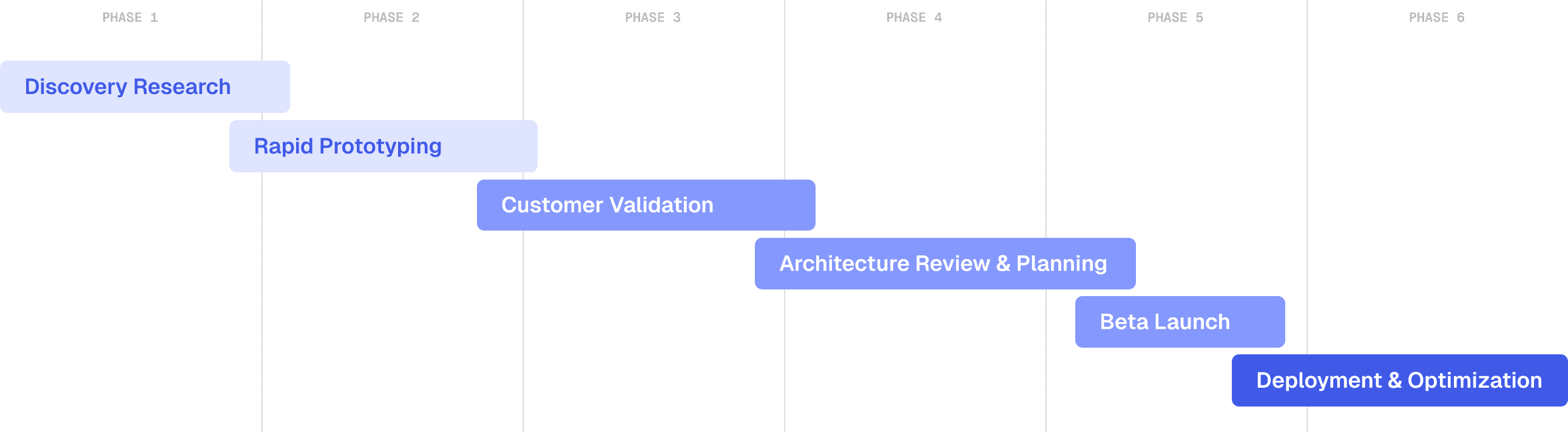
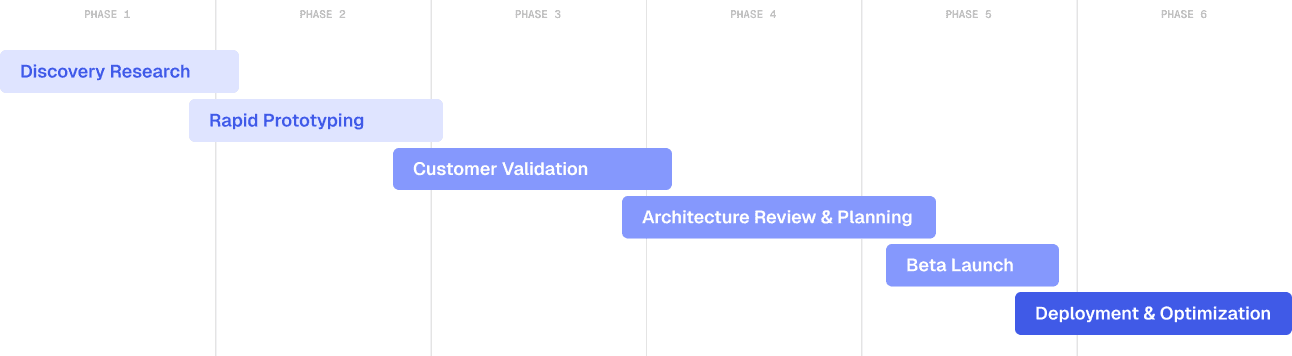
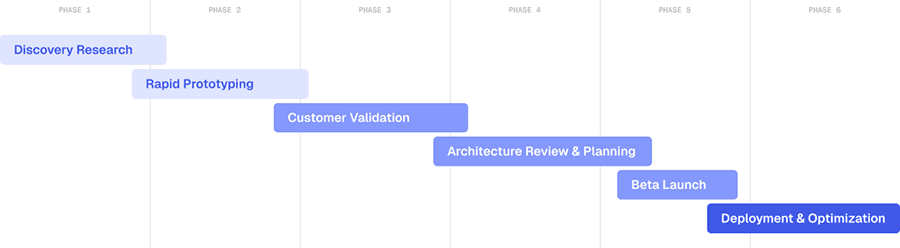
We approached the engagement with a discovery-first mindset. By combining customer interviews, rapid prototyping, and technical validation, we ensured that the metrics we built were both meaningful to users and scalable within the platform.
Process & Outcome
We approached the engagement with a discovery-first mindset. By combining customer interviews, rapid prototyping, and technical validation, we ensured that the metrics we built were both meaningful to users and scalable within the platform.
01.
Customer-Led Metric Definition
02.
Rapid AI-Powered Prototyping
03.
Embedded Workflow Intelligence
Rather than assuming which analytics would be most valuable, we began with structured customer discovery. We interviewed a select group of the platform’s most engaged enterprise clients to understand how they measured the effectiveness of their submission and approval workflows. These conversations revealed that volume and time-to-approval metrics were critical — not only for operational oversight, but for internal accountability and service-level management. Importantly, clients were not just looking for raw data. They wanted clarity: metrics that were intuitive, actionable, and aligned with how their organizations actually operated.

01.
Customer-Led Metric Definition
Rather than assuming which analytics would be most valuable, we began with structured customer discovery. We interviewed a select group of the platform’s most engaged enterprise clients to understand how they measured the effectiveness of their submission and approval workflows. These conversations revealed that volume and time-to-approval metrics were critical — not only for operational oversight, but for internal accountability and service-level management. Importantly, clients were not just looking for raw data. They wanted clarity: metrics that were intuitive, actionable, and aligned with how their organizations actually operated.

02.
Rapid AI-Powered Prototyping
03.
Embedded Workflow Intelligence
The Results
To ensure the analytics delivered measurable value, we structured the engagement around a simple principle: validate before building. Rather than leading with engineering assumptions, we grounded the solution in customer discovery, rapid prototyping, and technical validation. This approach allowed us to align on the right metrics, the right visualizations, and the right architectural implementation before committing to development.
12
New customer reports showcasing metrics around content uploads and approval workflows
75%
Reduction in time spent generating outside or external reports versus those now available inside of the platform
The Results
To ensure the analytics delivered measurable value, we structured the engagement around a simple principle: validate before building. Rather than leading with engineering assumptions, we grounded the solution in customer discovery, rapid prototyping, and technical validation. This approach allowed us to align on the right metrics, the right visualizations, and the right architectural implementation before committing to development.
12
New customer reports showcasing metrics around content uploads and approval workflows
75%
Reduction in time spent generating outside or external reports versus those now available inside of the platform