Previdi: PLCP's AI Intelligence Platform for Personal Injury Law
Roko Labs partnered with Physician Life Care Planning (PLCP) to build Previdi, case intelligence for personal injury firms. Built on Claude, Previdi turns thousands of pages of medical records into a clear, sourced case dashboard and a projected case value range grounded in PLCP's Intelligence Core. Previdi IQ lets firms query the full record conversationally, with every answer linked to its source.

Industry
Product
Previdi
The Challenge
Personal injury firms decide early which cases to take on and how much to invest in them. That decision rests on the medical records, which for a serious injury can run to thousands of pages across years of treatment. Today an attorney or paralegal reads those records by hand to piece together the injuries, the treatment path, gaps in care, and what future care the client will need. Manually reviewing a typical case (~2,500 pages of medical records) can take up to a full work week, 40+ hours of attorney or paralegal time.
Even after that review, the hardest question an attorney faces is how to estimate the future medical costs that are a key driver to the value of a case. Firms typically estimate them from senior attorney judgment, past settlements, or by retaining a physician or life care planner, which comes later and costs more.
Physician Life Care Planning (PLCP) is a leader in life care planning and damages valuation services for personal injury litigation and has spent decades producing physician-authored, life care plans, building an Intelligence Core of millions of Future Medical Requirements (FMRs). PLCP set out to put that expertise in front of firms at the very start of a case, with a platform built to help them decide, not just summarize. To do it, PLCP partnered with Roko Labs to build an AI pipeline it fully owns and controls.
The Solution
Roko Labs and PLCP built Previdi, case intelligence for personal injury firms, with Claude doing the reading. A firm uploads a case’s medical records, and Claude organizes what’s documented into a single dashboard, with every finding linked back to the source record.
Claude powers the two capabilities at the heart of Previdi:
A 360° view of every case. The dashboard surfaces Injury & Diagnoses by body system, Key Considerations such as delays in care or missed appointments, a Care Summary, a Case Timeline with gaps in care, and Future Recommendations for physician-anticipated care not yet delivered.
RangeFinder. A projected nominal value range for the case, benchmarked against PLCP’s Intelligence Core of millions of de-identified Future Medical Requirements (FMRs) specified by board-certified physicians and broken down by life care plan category.
Owning the full pipeline gives PLCP control over accuracy and traceability, and the freedom to keep evolving the product. When a case warrants full development, firms can move straight into PLCP damages valuation services from within Previdi, with their records and case data carried forward.
The Approach
Building Previdi with Claude
Previdi's extraction pipeline runs on Claude Opus 4.6, accessed directly through the Claude API. What makes it work is the clinical expertise built into it: PLCP's business team authored, tested, and refined the prompts that guide Claude, and Roko engineered the pipeline around them. The principle throughout is that Claude organizes and surfaces what's documented in the record, and every finding traces back to its source.
Reading every page. When records are uploaded, each document is converted to text page by page and Claude writes a short summary of every page. These summaries become the foundation for everything downstream.
Targeted clinical extraction. PLCP's business team designed the extraction logic, and Roko worked alongside them to turn it into focused prompts, one per clinical category: procedures, diagnostics, hospitalizations, EMS, rehab, and visits. The two teams tested Claude's output against PLCP's deep subject matter expertise and refined the prompts until the results met PLCP's standard. Keeping each prompt focused improved accuracy, and running them in parallel lets large records process faster.
Diagnosis intelligence. Claude identifies the mechanism of injury, extracts diagnoses and affected body parts, and captures ICD-10 codes. Where a record uses an older system such as ICD-9, Claude infers the ICD-10 equivalent. It then maps each diagnosis to PLCP’s diagnosis categories.
The case dashboard. Claude’s structured output feeds the Injury & Diagnoses, Key Considerations, Care Summary, Case Timeline, and Future Recommendations modules, with duplicates removed and gaps in care flagged. Claude also connects physician-recommended future care to treatment already delivered.
RangeFinder. The injuries and diagnoses Claude extracts are benchmarked against de-identified FMRs from PLCP’s Intelligence Core to project a nominal value range, broken down by life care plan category. Claude reads the case; the range comes from decades of physician-authored data, not an AI guess.
Measurable Impact
Results
From a week of manual review to a few hours. Reviewing a 2,500-page medical record can take an attorney up to a full week of work: 40 hours of reading, sorting records from multiple providers, building a timeline, and piecing together the injuries and future care needs. With Previdi, Claude processes the same records and the firm is reviewing a sourced case dashboard in around two to four hours, cutting time to a case decision by 90–95%.
A case value range before committing resources. With RangeFinder, firms get a projected nominal value range for Future Medical Requirements at intake, rather than waiting until later in the case to retain an expert. No other case evaluation product offers this, because it rests on PLCP's own body of physician-authored future medical requirements.
Earlier, more confident decisions. Personal injury firms using Previdi today catch injuries, gaps in care, and other key considerations at the start of a case, when they matter most for deciding whether to take it on and how much to invest.
A platform PLCP controls. Owning a Claude-based pipeline gives PLCP control over accuracy and traceability, and the freedom to keep improving Previdi as firms' needs evolve.
From the Previdi Team
"Partnering with Roko to build Previdi natively on Claude gave us full control of the prompts, so every output reflects our decades of expertise and meets our standard for accuracy, security and speed. Paired with our Intelligence Core, it lets us give firms something no one else can: a projected case value range through RangeFinder, grounded in decades of physician-authored Future Medical Requirements. That's what turned Previdi from a vision into a product firms can rely on with confidence."
Darin LeGrange, Chief Product Officer - Previdi / PLCP
Have a similar task or project?
Let's talk about it!
One Screen. The Whole Case.
Previdi Dashboard
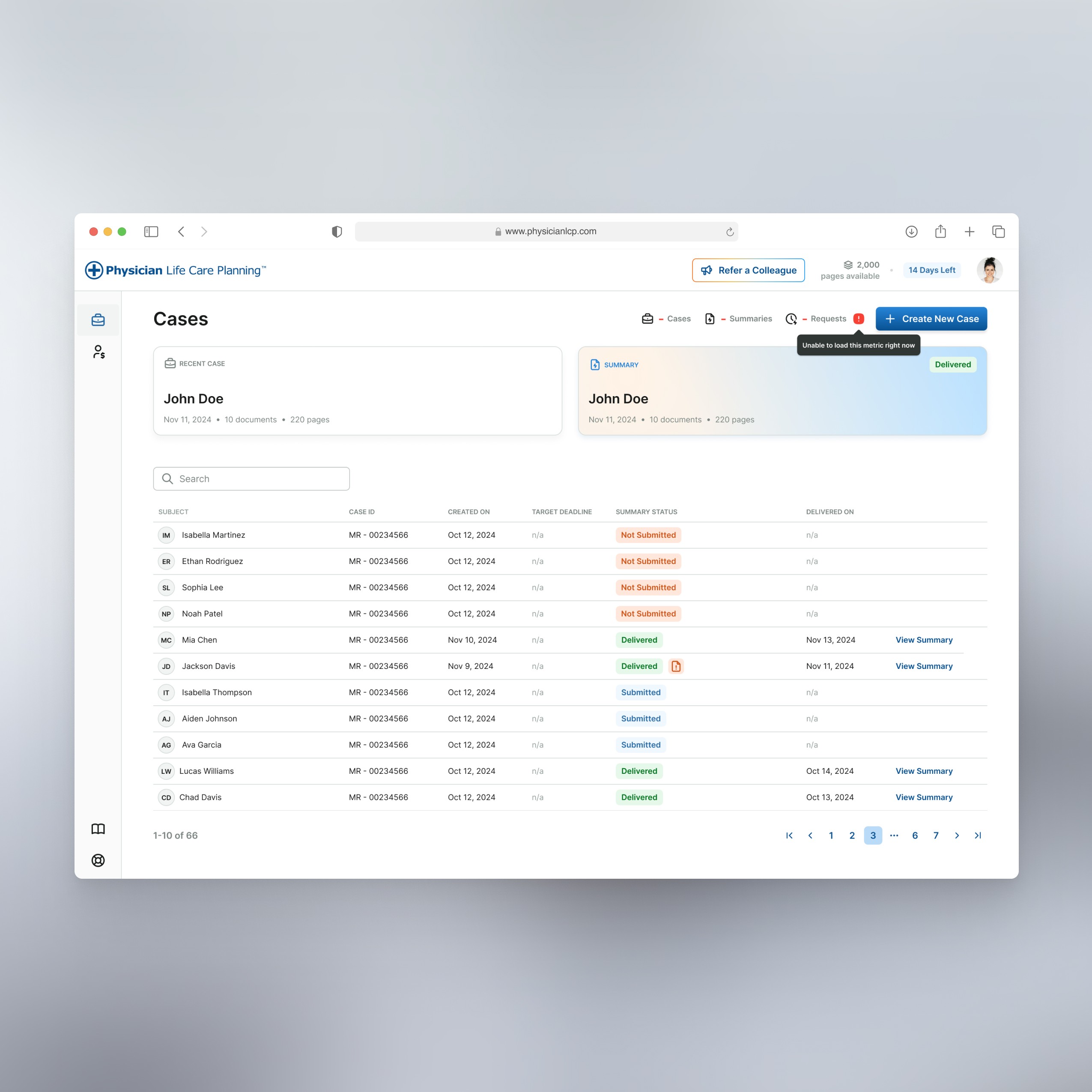
The Previdi dashboard gives personal injury attorneys and paralegals a 360° view of every case: a consolidated, structured picture of the medically relevant information in a case's records. Its purpose is to help firms evaluate new cases quickly, determine case viability, identify potential risks, and understand the full treatment picture without manually reviewing every record.
After records are converted to text, Claude extracts and organizes the documentation into actionable insights across a series of modules: Injury & Diagnoses, Key Considerations, Care Summary, Case Timeline, and Future Recommendations. Each module focuses on a specific aspect of the case, with drill-down views available when needed, and every finding links back to the source record.
The result is immediate clarity on the nature of the injury, the treatment path, documented issues that can shape a case, and future care needs: the signals firms need to decide whether to commit to a case and how to value it.
Every Diagnosis, Sourced.
Injury and Diagnosis
Medical records often span thousands of pages and years of treatment. Injury & Diagnoses brings together the symptoms, diagnoses, and impairments documented across all records, organized by body system with the most-referenced findings surfaced first.
Instead of scanning summaries or raw documents, users can quickly see which conditions are present, when they appear, and how they evolve, all mapped to a body diagram. Every diagnosis links to its source material for full transparency and review.
This supports faster case understanding without sacrificing accuracy or trust.

The Full Story of Care
Case Timeline
Understanding a case often means understanding when care occurred over time.
The Case Timeline tells the full story from the date of injury forward, turning unstructured medical records into a chronological view of clinical visits, diagnostics, procedures, and treatments. Drawn straight from the dates and notes in the records, it helps users quickly spot patterns, delays, and gaps in care that might otherwise stay buried in the documentation.
Hundreds or thousands of records become an easy-to-parse timeline, enabling faster comprehension and more informed decisions.

Intelligence Dashboard
Previdi IQ
Previdi IQ lets users query thousands of pages conversationally and get structured, cited answers.
Rather than relying on keyword search, users can explore prior injuries, treatment history, or reported symptoms, and every answer links to the exact source in the record, supporting validation and professional review. Suggested prompts give quick access to key case information and adapt as the conversation continues.
This makes Previdi an active investigation aid that firms can use throughout the life of a case, not just a summarization tool.