Case Study

Range Finder: AI Driven Predictive Life Care Cost Modeling

Title

Physician Life Care Planning needed to give law firms a defensible projection of lifetime medical costs before those firms committed years of capital to a catastrophic injury case. Over six months, Roko Labs built Range Finder. This AI system places every new subject into a high-dimensional clinical vector space and returns a peer-matched cost projection grounded in real historical outcomes.
The Challenge

Plaintiff law firms decide whether to take a catastrophic injury case before they know what the long-term medical care will cost. The cases run for years and the numbers are large, so a wrong call is expensive in both directions.


Three pressures converge at intake:

  • Volume of evidence. A spinal cord or traumatic brain injury file can run thousands of pages of records, expert reports, and historical settlements, none of it queryable at intake speed.

  • Capital at risk. A case with limited recovery will burn years of funding before that becomes obvious.

  • Noisy estimation. Conventional projections rely on expert judgment and small comparable sets. Hard to reproduce, harder to defend, easy to attack in deposition.


Two senior partners read the same file and reach different conclusions, with no shared framework underneath the disagreement.

The Vision

The brief was specific. Build a system that takes a new injury profile and returns a defensible projected cost range, grounded in genuinely comparable historical cases, fast enough to be useful at intake.

That meant three things in practice:


  1. Every historical case had to live inside a single analytical space, not a folder of PDFs.

  2. A new subject had to be placed into that space using the same diagnostic and clinical features as the historical cohort, not surface-level demographics.

  3. The output had to be transparent. A partner had to be able to look at the underlying peer set and see why the projection came out where it did.


Range Finder had to give law firms an answer at intake that they would still defend at trial.

The Approach

The Approach

How It Works: Similarity Modeling on a Clinical Vector Space

How It Works: Similarity Modeling on a Clinical Vector Space

How It Works: Similarity Modeling on a Clinical Vector Space


Range Finder represents every case, historical and new, as a vector in a high-dimensional clinical space built from diagnostic conditions, injury classification, and subject age. A new subject is mapped into the same space, and the model returns the nearest neighbors using a KNN-based similarity algorithm.


Three guardrails keep the peer set medically defensible:

  • Primary diagnostic conditions carry the heaviest weight.

  • Injury classification (spinal cord injury, traumatic brain injury, and others) must match before any neighbor is admitted.

  • Subject age sits inside a constrained band rather than as an open variable.


The result is a peer set that holds up to medical scrutiny, not a statistical neighborhood that happens to be close in feature space.


Range Finder represents every case, historical and new, as a vector in a high-dimensional clinical space built from diagnostic conditions, injury classification, and subject age. A new subject is mapped into the same space, and the model returns the nearest neighbors using a KNN-based similarity algorithm.


Three guardrails keep the peer set medically defensible:

  • Primary diagnostic conditions carry the heaviest weight.

  • Injury classification (spinal cord injury, traumatic brain injury, and others) must match before any neighbor is admitted.

  • Subject age sits inside a constrained band rather than as an open variable.


The result is a peer set that holds up to medical scrutiny, not a statistical neighborhood that happens to be close in feature space.

End-to-End Pipeline

Key Capabilities

Key Capabilities

Key Capabilities


Once the peer set is fixed, Range Finder runs a five-stage calculation to produce a single Nominal Value, the projected lifetime cost of recommended medical treatment for the subject.


  • Duration of care. How long comparable subjects historically required active medical care.

  • Inflation-adjusted costing. Future Medical Recommendations and inflation rates normalize historical costs to present-day values.

  • Annualized cost. Treatment frequency and unit pricing produce an average annual cost.

  • Adjusted life expectancy. Subject-specific and cohort-based data refine the duration over which costs accrue.

  • Final Nominal Value. Annual cost and adjusted duration combine into a single lifetime projection.


Every stage is auditable. Every stage cites the peer cohort it was derived from.


Once the peer set is fixed, Range Finder runs a five-stage calculation to produce a single Nominal Value, the projected lifetime cost of recommended medical treatment for the subject.


  • Duration of care. How long comparable subjects historically required active medical care.

  • Inflation-adjusted costing. Future Medical Recommendations and inflation rates normalize historical costs to present-day values.

  • Annualized cost. Treatment frequency and unit pricing produce an average annual cost.

  • Adjusted life expectancy. Subject-specific and cohort-based data refine the duration over which costs accrue.

  • Final Nominal Value. Annual cost and adjusted duration combine into a single lifetime projection.


Every stage is auditable. Every stage cites the peer cohort it was derived from.

The Range FInder

Evolution of Concept

Evolution of Concept

Evolution of Concept


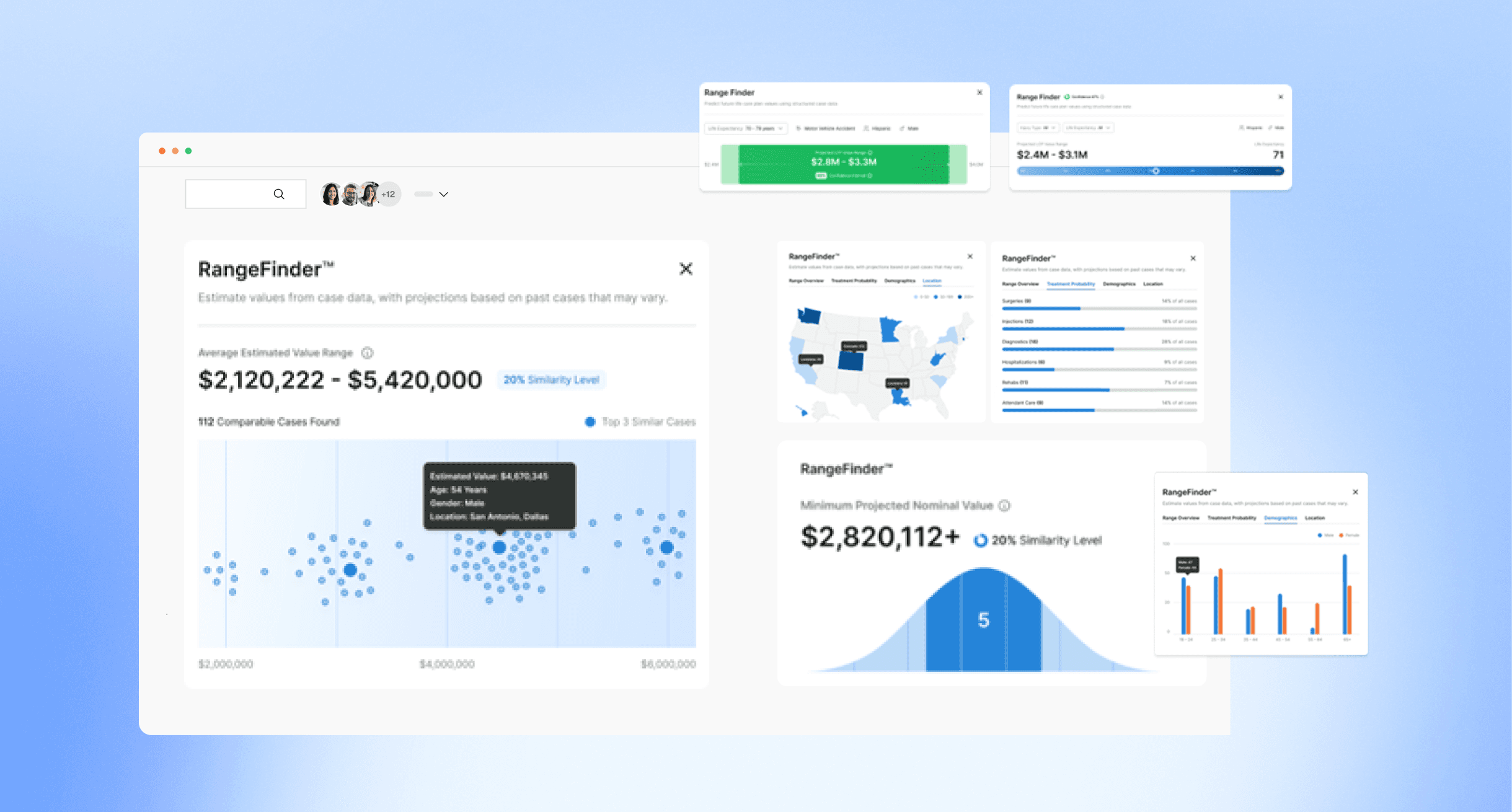
The interface went through three rounds before it shipped.


Version one established the baseline and introduced a life expectancy slider so users could see how assumptions moved the projection in real time.


Version two added statistical distributions to anchor the projection against similarity confidence. Version three, the current build, cut the rare outliers and surfaced a scatter plot of the matched historical cases on the projection screen.


The scatter plot was the decisive change. A senior partner can now look at the peer set and confirm visually that the projection is grounded in cases that resemble the one in front of them, before they commit capital.


The interface went through three rounds before it shipped.


Version one established the baseline and introduced a life expectancy slider so users could see how assumptions moved the projection in real time.


Version two added statistical distributions to anchor the projection against similarity confidence. Version three, the current build, cut the rare outliers and surfaced a scatter plot of the matched historical cases on the projection screen.


The scatter plot was the decisive change. A senior partner can now look at the peer set and confirm visually that the projection is grounded in cases that resemble the one in front of them, before they commit capital.

Customer Outcomes

Results

Results

Results


Range Finder is a case selection system, not a calculator. At intake, a partner enters a new subject and receives a peer-matched cost range with the underlying historical cohort visible on screen. The firm now has a defensible projection of Nominal Value before it invests in expert reports, discovery, or trial preparation.


Two outcomes follow directly:

  • Firms reject cases earlier when the peer set shows the recovery will not justify the capital required.

  • Firms commit to cases with greater confidence when the peer set supports the valuation.


The visual peer cohort also changed how projections hold up in negotiation and deposition. The number is no longer an expert opinion against an opposing expert opinion. It is a position grounded in a named cohort of comparable historical cases, reproducible from the same inputs, and visible to everyone in the room.


For Physician Life Care Planning, Range Finder turned a manual, expert-driven assessment into a system that scales across every intake their customers run.


Range Finder is a case selection system, not a calculator. At intake, a partner enters a new subject and receives a peer-matched cost range with the underlying historical cohort visible on screen. The firm now has a defensible projection of Nominal Value before it invests in expert reports, discovery, or trial preparation.


Two outcomes follow directly:

  • Firms reject cases earlier when the peer set shows the recovery will not justify the capital required.

  • Firms commit to cases with greater confidence when the peer set supports the valuation.


The visual peer cohort also changed how projections hold up in negotiation and deposition. The number is no longer an expert opinion against an opposing expert opinion. It is a position grounded in a named cohort of comparable historical cases, reproducible from the same inputs, and visible to everyone in the room.


For Physician Life Care Planning, Range Finder turned a manual, expert-driven assessment into a system that scales across every intake their customers run.

Have a similar problem? Get in touch.

aria-label="Home"

Copyright © 2026 Roko Labs Inc.

All rights reserved.

1250 Broadway, 36th Floor, New York, NY, 10001

aria-label="Home"

Copyright © 2026 Roko Labs Inc.

All rights reserved.

1250 Broadway, 36th Floor, New York, NY, 10001

aria-label="Home"

Copyright © 2026 Roko Labs Inc.

All rights reserved.

1250 Broadway, 36th Floor, New York, NY, 10001

aria-label="Home"

Copyright © 2026 Roko Labs Inc.

All rights reserved.

1250 Broadway, 36th Floor, New York, NY, 10001