Case Study

Creating an AI-First Development Infrastructure for a Leading Hedge Fund

A leading hedge fund engaged the team at Roko Labs to redesign its software development lifecycle around AI-first principles. The primary goal was to increase cost efficiency and engineering productivity by reducing manual development effort, minimizing rework, and accelerating delivery. Instead of introducing isolated AI tools, Roko Labs embedded AI directly into development infrastructure and workflows. This enabled a shift toward a structured, agent-assisted model where AI supports requirement interpretation, code generation, and iterative refinement within the existing repository and CI/CD ecosystem.

Case Study

Creating an AI-First Development Infrastructure for a Leading Hedge Fund

A leading hedge fund engaged the team at Roko Labs to redesign its software development lifecycle around AI-first principles. The primary goal was to increase cost efficiency and engineering productivity by reducing manual development effort, minimizing rework, and accelerating delivery. Instead of introducing isolated AI tools, Roko Labs embedded AI directly into development infrastructure and workflows. This enabled a shift toward a structured, agent-assisted model where AI supports requirement interpretation, code generation, and iterative refinement within the existing repository and CI/CD ecosystem.

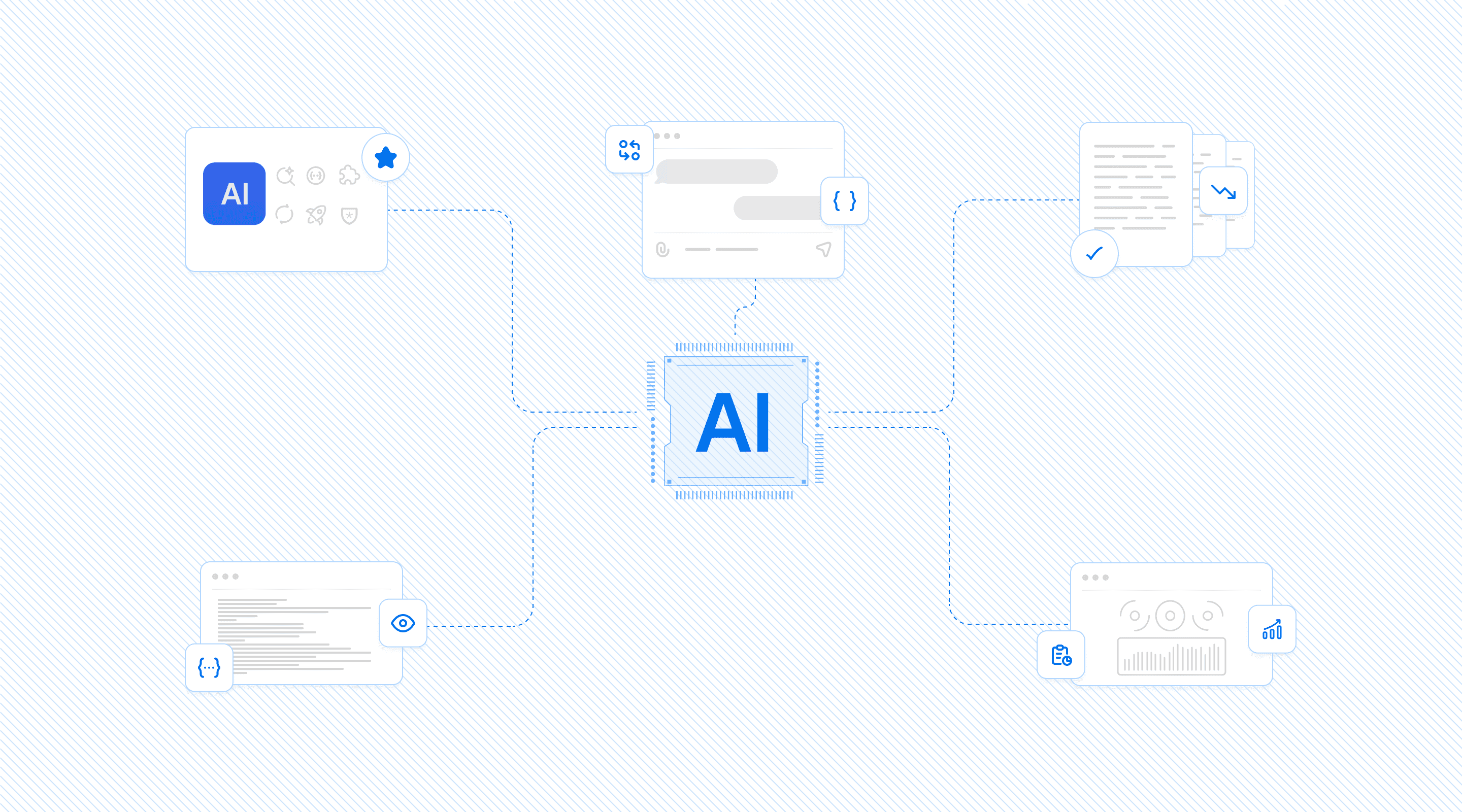
Illustration of an AI‑powered software delivery workflow showing a central AI engine connected to code, testing, documentation, validation, and system analysis pipelines, representing reusable AI workflows and automation across engineering teams.

Client

SummitTX

https://www.summittxcapital.com/

Industry

Financial Services

Services

Development Services AI Optimization

Project Duration

2 Months

Illustration of an AI‑powered software delivery workflow showing a central AI engine connected to code, testing, documentation, validation, and system analysis pipelines, representing reusable AI workflows and automation across engineering teams.

Client

SummitTX

https://www.summittxcapital.com/

Industry

Financial Services

Services

Development Services AI Optimization

Project Duration

2 Months

Illustration of an AI‑powered software delivery workflow showing a central AI engine connected to code, testing, documentation, validation, and system analysis pipelines, representing reusable AI workflows and automation across engineering teams.

Client

SummitTX

https://www.summittxcapital.com/

Industry

Financial Services

Services

Development Services AI Optimization

Project Duration

2 Months

The Challenge

The client’s engineering organization faced structural inefficiencies that limited throughput and consistency: - Manual translation of requirements into code, creating latency between ticket creation and implementation - High variance in code quality, dependent on individual developer expertise - Limited integration of AI tooling, resulting in fragmented and non-reproducible workflows - Late-stage defect detection, increasing the cost of iteration Additionally, existing development practices were not designed to leverage AI-systems that can generate and iterate on code autonomously within controlled environments. These limitations constrained both development velocity and cost-efficiency.

The Vision

The client aimed to transition from a developer-driven workflow to an AI-assisted development model that improves efficiency and consistency. The objective was to establish a repeatable system where requirements could be translated into production-ready code with minimal manual intervention. This required embedding AI into the development lifecycle while maintaining alignment with existing repositories and workflows. A key focus was increasing the probability of correct outcomes early in the development process, reducing rework and overall development cost.

The Challenge

The client’s engineering organization faced structural inefficiencies that limited throughput and consistency: - Manual translation of requirements into code, creating latency between ticket creation and implementation - High variance in code quality, dependent on individual developer expertise - Limited integration of AI tooling, resulting in fragmented and non-reproducible workflows - Late-stage defect detection, increasing the cost of iteration Additionally, existing development practices were not designed to leverage AI-systems that can generate and iterate on code autonomously within controlled environments. These limitations constrained both development velocity and cost-efficiency.

The Vision

The client aimed to transition from a developer-driven workflow to an AI-assisted development model that improves efficiency and consistency. The objective was to establish a repeatable system where requirements could be translated into production-ready code with minimal manual intervention. This required embedding AI into the development lifecycle while maintaining alignment with existing repositories and workflows. A key focus was increasing the probability of correct outcomes early in the development process, reducing rework and overall development cost.

The Challenge

The client’s engineering organization faced structural inefficiencies that limited throughput and consistency: - Manual translation of requirements into code, creating latency between ticket creation and implementation - High variance in code quality, dependent on individual developer expertise - Limited integration of AI tooling, resulting in fragmented and non-reproducible workflows - Late-stage defect detection, increasing the cost of iteration Additionally, existing development practices were not designed to leverage AI-systems that can generate and iterate on code autonomously within controlled environments. These limitations constrained both development velocity and cost-efficiency.

The Vision

The client aimed to transition from a developer-driven workflow to an AI-assisted development model that improves efficiency and consistency. The objective was to establish a repeatable system where requirements could be translated into production-ready code with minimal manual intervention. This required embedding AI into the development lifecycle while maintaining alignment with existing repositories and workflows. A key focus was increasing the probability of correct outcomes early in the development process, reducing rework and overall development cost.

The Solution

Roko Labs designed and implemented an AI-first development infrastructure centered around AI agents, automated workflows, and developer-in-the-loop validation. Agent-Driven Development Workflow - Interprets tickets and requirements - Generates code within the repository - Automatically creates branches and pull requests - Iterates based on feedback and validation Repository-Native Integration - AI agents interact with the codebase in context - Code generation is tied to version control workflows - Outputs are versioned, reviewable, and reproducible Interface-Agnostic Architecture - Supports multiple LLM providers and interfaces - Allows flexibility in tooling choices - Enables future upgrades without re-architecting the system Controlled Execution Environments - AI workflows run within local or controlled virtual environments - Sensitive code remains within the client’s infrastructure - Developers retain full visibility into all generated outputs Developer-in-the-Loop - Review and validate AI-generated code - Provide feedback to improve generation accuracy - Focus on higher-level problem solving rather than manual implementation

Implementation and Results

Roko Labs executed the solution in phases, starting with the integration of AI agents into the client’s repository and ticketing systems, followed by the enablement of ticket-to-code pipelines and iterative refinement loops. As adoption increased, workflows were standardized and optimized to improve consistency and reliability across teams. In early adoption, the system has already demonstrated measurable improvements: - Reduced time from ticket creation to initial implementation - Increased development throughput across engineering teams - Improved consistency in code structure and patterns - Reduced rework through higher first-pass accuracy Most importantly, the system increases the probability of correct outcomes earlier in the development lifecycle, which directly contributes to cost efficiency. This approach establishes a scalable foundation for AI-assisted development, where engineers focus on validation and orchestration while AI handles routine implementation tasks, improving both efficiency and cost structure over time.

Need help scaling AI development to your business needs? Contact us.

Have a similar task or project? Let's talk about it!

Have a similar task or project? Let's talk about it!

aria-label="Home"

Copyright © 2026 Roko Labs Inc.

All rights reserved.

1250 Broadway, 36th Floor, New York, NY, 10001

aria-label="Home"

Copyright © 2026 Roko Labs Inc.

All rights reserved.

1250 Broadway, 36th Floor, New York, NY, 10001

aria-label="Home"

Copyright © 2026 Roko Labs Inc.

All rights reserved.

1250 Broadway, 36th Floor, New York, NY, 10001

aria-label="Home"

Copyright © 2026 Roko Labs Inc.

All rights reserved.

1250 Broadway, 36th Floor, New York, NY, 10001